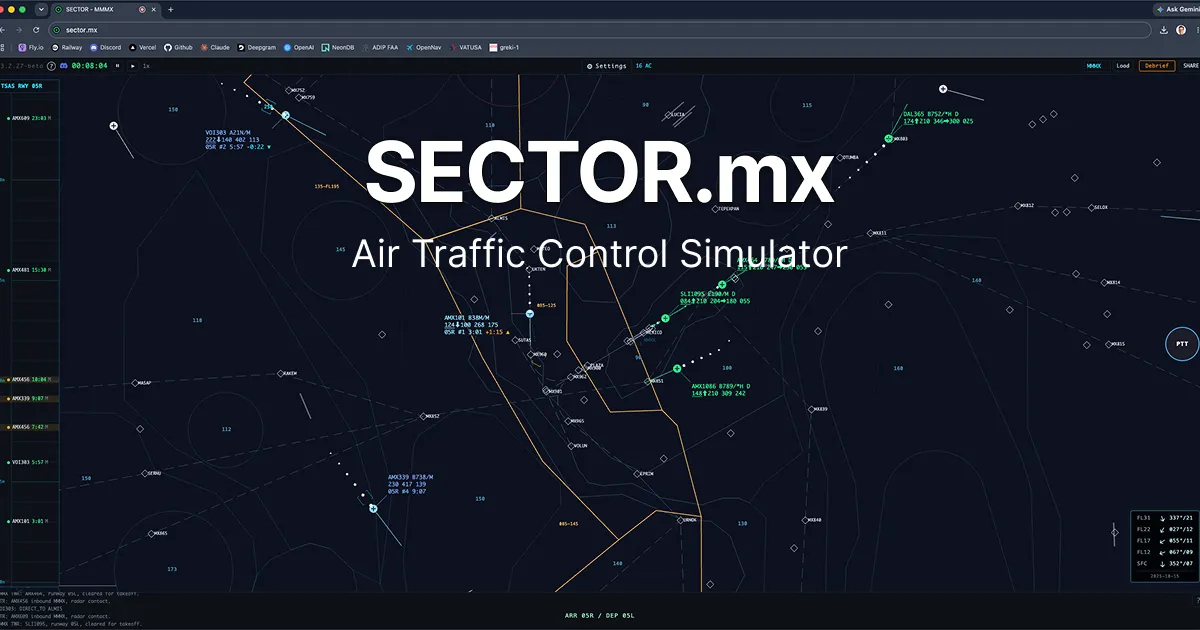
Mexican airspace is not US airspace with different names on the fixes. Mexico City sits in a valley above 7,000 feet, boxed in by mountains. The ~18,000 ft Popocatépetl to the southeast, the ~13,000 ft Ajusco to the southwest. This changes how traffic descends and how much room you actually have to work with. The arrival flows have their own shape. And the radio is in Spanish, with phraseology that is not a translation of the FAA version. A pilot going around is told “ida al aire,” not “go around.” Getting that right is not a localization task. It changes who the simulator is for.
The first airspace I built was Mexico City, MMMX. That wasn’t a data decision or a market decision. My father worked that airspace for most of his career, 41 years, as an approach controller for Mexico City. I grew up around it, literally. My grandparents’ home was about two miles under the 05L glide path. The Concorde broke a few of their windows in the 80s.
Building it for a place I actually knew mattered more than I expected when I started. Most sims treat the airspace as a backdrop and put the real work into the UI. I wanted it the other way around: an airspace that someone who flies it, or has worked it, would recognize as theirs.
People have been portraying this valley for centuries. Thomas Kole’s Retrato de Tenochtitlan is a gorgeous reconstruction of the lake-city that stood here before there was any airspace to control.
SECTOR.mx is not only Mexico now. I have since built KJFK, ZNY, and others, and people control them every day. But Mexico is where it began, and it is still the part I care about most. Not a generic radar scope with Mexican labels on it. The actual airspace, for the people who know it.